Why internalizing critical processing reduces operational risk
In OEM manufacturing, operational risk almost never arises from a single isolated error. It arises from the difficulty of controlling complex processes distributed along an increasingly fragmented supply chain, where each additional interface can become a point of discontinuity. For many companies that produce complex machinery or systems (such as, for example, earthmoving equipment, agricultural equipment or goods handling equipment), component quality is no longer sufficient: today, speed of reaction, traceability, process stability and containment capabilities count. This is why more and more technical buyers, SQEs and production managers are reevaluating the role of internalizing critical processing. Not as an ideological choice, but as a concrete lever to reduce operational risk, increase control over special features, and improve supply chain resilience.
Operational risk arises not just from the defect, but from the time it takes to contain it
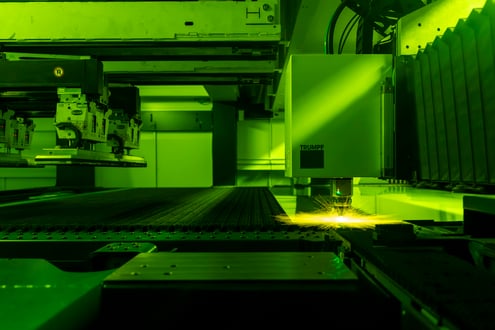
In the lifting equipment, construction equipment, and agricultural equipment industries, the most costly problem is almost never the single nonconformity.
The real cost arises the moment the company has to figure it out quickly:
- where the problem arose,
- which lots are involved,
- which components need to be blocked,
- which suppliers need to be involved,
- and most importantly, how to prevent the defect from continuing to propagate down the production line or into the market.
When this process takes hours, or worse days, operational risk increases exponentially.
For a quality or production manager, the critical point is not just "having a defect," but being able to contain it immediately, isolating it without compromising production continuity, deliveries, and OEM reputation.
And this is where one of the most underestimated limitations of fragmented supply chains emerges.
When critical processing is spread over multiple external suppliers, with intermediate steps, off-site rework and poorly integrated processes, reconstructing the actual supply chain becomes much more complex. Each additional step introduces new variables:
- longer response times,
- loss of operational information,
- less control over process parameters,
- difficulty in reconstructing responsibilities,
- greater exposure to tracking errors.
More recent frameworks on industrial traceability insist on this very point: without reliable data on provenance, process events, time windows, and production pedigree, it becomes much more difficult to quickly identify disruptions, anomalies, or operational responsibilities.
For this reason, many OEMs today require traceability systems capable of linking each component to:
- lot
- production window
- material used
- processing parameters
- quality controls
- and specific process performed
The goal is by no means bureaucratic but, totally operational.
Because when a critical issue emerges, the difference between effective management and a production crisis depends on how quickly you can circumscribe the problem.
And it is exactly in this scenario that the internalization of critical processing becomes a strategic advantage.
Having multiple integrated processes within the same production partner means drastically reducing supply chain blind spots. It means being able to intervene more quickly, accurately reconstruct the production flow and contain risk before it turns into downtime, recall or escalation to the end customer.
In markets where reliability, continuity and responsiveness are crucial, the ability to directly control the most sensitive production steps is no longer just an industrial advantage but is becoming a competitive requirement.
What makes a processing really critical
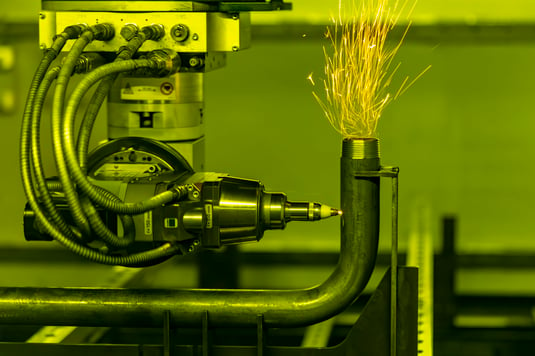 In OEM parlance, a machining operation does not become "critical" simply because it is complex or expensive.
It becomes critical when it has a direct impact on one or more key elements of the final product:
- safety,
- regulatory compliance,
- operational reliability,
- performance,
- fit/form/function,
- perceived quality,
- or stability of subsequent production stages.
In other words, a machining operation is critical when an anomaly, even a minor one, can generate knock-on effects throughout the supply chain or on the operation of the finished machine.
This is why, in the heavy equipment, HVAC, material handling and industrial automotive sectors, manufacturers classify certain features as:
- Critical Characteristics,
- Special Characteristics,
- Key Product Characteristics,
- or Special Processes.
These elements require much higher levels of control than normal manufacturing processes.
It is not just a matter of checking the final part. The entire process must be presided over.
For this reason, critical features must be formally managed within:
- Process FMEAs,
- Control Plan,
- operating instructions,
- sampling plans,
- traceability systems,
- quality records,
- process validations,
- and periodic audits.
The goal is to reduce risk before the problem manifests itself in the field. And that's where so-called "special processes" come in.
Indeed, there are processes whose outcome cannot be fully verified by final inspection alone. In these cases, compliance depends on the stability and validation of the process itself.
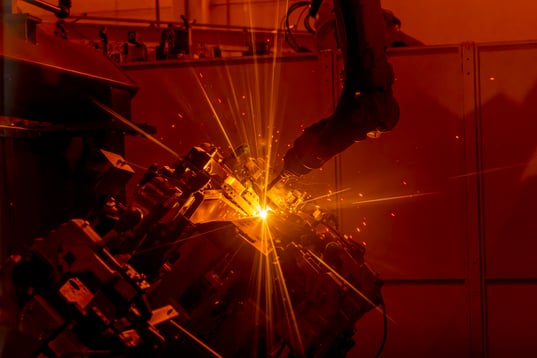 Among the most typical examples:
- welding,
- painting,
- cataphoresis,
- surface treatments,
- structural bonding,
- critical assemblies,
- thermal processes,
- and some high-precision plastic processing.
Seemingly correct welding can hide internal defects; or improperly controlled painting can compromise corrosion resistance over time.
Out-of-tolerance assembly can generate vibration, premature wear, or machine downtime.
That's why OEMs require formal validations, monitored parameters, skilled operators and continuous process records.
It's not just a quality requirement. It is a logic of industrial risk reduction.
In the industrial machinery sector, the cost of failure in the field is not just measured in component replacement.
It can translate into:
- machine downtime,
- warranty interventions,
- extraordinary logistics costs,
- line downtime,
- loss of productivity,
- escalation to the end customer,
- and reputational damage.
This is why large OEMs today tend to favor manufacturing partners capable not only of "making the part," but of directly controlling the critical processes that determine reliability and business continuity.
When critical machining is managed in-house, with integrated processes and centralized production data, the level of control increases dramatically.
And with it also increases the ability to prevent problems before they become costs.
Why selectively internalizing critical processing reduces operational risk
In recent years, many industrial OEMs have discovered that the real supply chain problem is not just the cost of supply. Rather, it is the loss of control over the processes that determine quality, production continuity and reliability of the final product.
For this reason, more and more companies are reevaluating a selective integration approach to critical processing.
This does not mean "doing everything in-house," but it does mean directly overseeing the steps that have the greatest impact on operational risk.
When critical processing is spread across multiple external suppliers, they inevitably increase:
- the interfaces to be coordinated,
- the information steps,
- the uncontrolled variables,
- the reaction times,
- and the overall complexity of industrial governance.
Each additional interface introduces a potential point of discontinuity.
This becomes even more apparent in OEM contexts where they coexist:
- high customization,
- product variants,
- frequent engineering changes,
- rapid ramp-ups,
- and constant pressure on lead times.
In these scenarios, the issue is not just "who makes the part."
The issue is how quickly the entire chain can take in a change, handle a deviation, or isolate a defect.
And this is where selective internalization radically changes the level of operational control.
When processes such as carpentry, robotic welding, laser machining, painting, assembly or stamping are managed within an integrated manufacturing ecosystem:
- the number of handoffs is reduced,
- engineering communication becomes faster,
- engineering change management is smoother,
- and the decision cycle is shortened dramatically.
The most important benefit, however, concerns speed of response.
In the presence of a nonconformity, an integrated organization is able to:
- identify the cause more quickly,
- activate immediate containments,
- segregate the lots involved,
- verify serials and traceability,
- correct process parameters,
- and restart production in a much shorter time.
In other words, the time between:
deviation → analysis → correction → restoration of stability.
This operational loop is one of the most critical elements in industrial OEM management today.
The supply chain resilience literature has long pointed out that greater vertical or operational integration increases the ability to control in highly critical processes, especially when the main risk is not the unit cost of the component but the impact of a failure on manufacturing continuity.
And that is exactly what the major OEM standards also require.
Heavy equipment and industrial manufacturers are increasingly demanding:
- validation of special processes,
- full product traceability,
- availability of SPC data,
- process records,
- batch and serial monitoring,
- controlled revision management,
- and immediate audit capability.
All of which become much more difficult to govern when critical processing is distributed across a highly fragmented supply chain.
This does not mean that outsourcing is wrong, but it does mean that not all processing carries the same strategic weight.
In fact, more advanced industrial companies are taking a much more selective approach:
- Outsourcing activities with low strategic impact,
- and keeping the processes that affect quality, reliability and business continuity under direct control.
For OEMs today, the real difference is not just the cost of the component.
It is the ability of the industrial partner to ensure process stability, speed of reaction and control throughout the production chain.
Which processes it is convenient to preside over in the same industrial perimeter
Not all processing has the same impact on operational risk.
However, there are some production sequences that, due to their technical nature and OEM requirements, become much more reliable when managed within the same industrial perimeter.
The reason is simple: each external transfer introduces a new interface.
.png?width=327&height=381&name=Progetto%20senza%20titolo%20(9).png)
And each additional interface increases the risk of:
- dimensional misalignments,
- surface variations,
- loss of process information,
- revision errors,
- logistical damages,
- delays in containment,
- and inconsistencies in quality control.
Therefore, in complex industrial production, the value lies not only in the individual technology.
It resides in the continuity of the production flow.
From laser cutting to carpentry: geometric continuity and tolerance control
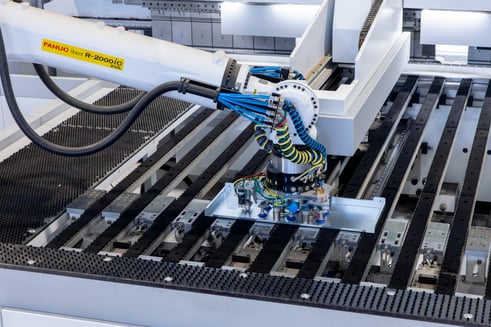 A typical example involves the sequence:
laser cutting → bending → carpentry → robotic welding.
When these processes are fragmented among different suppliers, the likelihood of tolerance buildup, unmanaged deformations, or differing interpretations of engineering data increases.
In contrast, managing the entire cycle in the same production ecosystem enables:
- maintain geometric consistency between stages,
- reduce rework,
- speed up feedback between production and quality,
- and quickly correct any dimensional deviations.
This becomes especially critical in structural components intended for:
- construction equipment,
- material handling equipment,
- industrial equipment,
- HVAC systems,
- or agricultural applications.
In these areas, even small deviations can generate problems with assembly, vibration, mechanical stress, or downstream functional inefficiencies.
Robotic welding and special processes: the value of direct governance
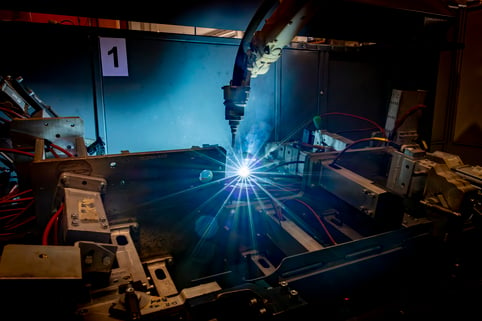 Welding represents one of the most sensitive special processes in the OEM world.
Manufacturers are increasingly demanding:
- Qualified WPS,
- operator/process traceability,
- parameter logging,
- special feature control,
- procedure validation,
- and full auditability.
When carpentry and robotic welding are governed at the same production site, it becomes much easier:
- correlate any defects to the source phase,
- manage immediate containments,
- preserve document continuity,
- and keep the process stable over time.
In practice, quality is not "controlled after the fact," but is built during the production flow.
Painting and cataphoresis: less manipulation, less surface variability
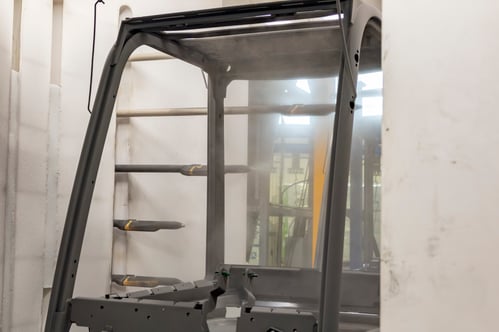 Surface processes also benefit greatly from integrated management.
Sequences such as:
carpentry → surface preparation → cataphoresis → painting → assembly
are particularly prone to variability when multiple external parties intervene.
Each additional transport increases the risk of:
- surface contamination,
- micro-damage,
- variations in preparation,
- adhesion problems,
- or aesthetic nonconformities.
When, on the other hand, the flow is kept internal:
- the time between processes is reduced,
- the management of preparation parameters is more stable,
- and quality control can verify continuity and consistency throughout the sequence.
This is especially important in industries where the aesthetic component and surface durability represent functional product characteristics.
Plastic molding, thermoforming and assembly: integration between component and final product
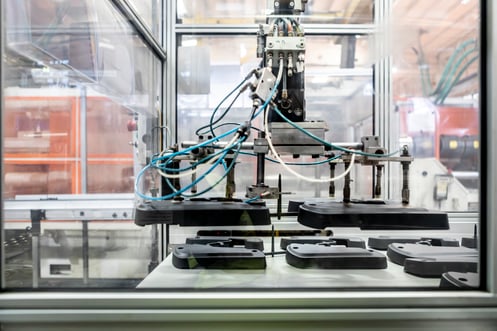 The same principle applies to the world of plastics.
Processes such as:
injection molding → thermoforming → finishing → assembly
require continuous alignment between:
- dimensional tolerances,
- material characteristics,
- process stability,
- and final functional requirements.
When processing is spread over multiple outside operators, the risk of loss of control over actual process variables increases.
In contrast, an integrated production perimeter allows:
- speed up validations,
- reduce the risk of incompatibility between components,
- manage engineering changes more quickly,
- and improve traceability throughout the production cycle.
The real advantage: reducing operational complexity
In the end, the point is not to "do more processing internally."
The real benefit is to reduce operational complexity at stages where quality, production continuity, and reliability depend on process stability.
When an OEM requires:
- validation of special processes,
- control of special features,
- full traceability,
- availability of process data,
- and rapid audit capability,
the value of an integrated manufacturing perimeter becomes extremely real, as the difference is not just in the ability to produce a component. It lies in the ability to consistently govern everything that happens between raw material, process, and final quality.
How a technical buyer or SQE measures a partner's soundness
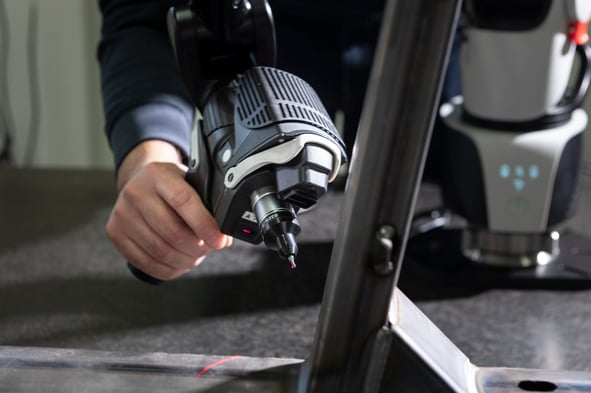 In the industrial OEM world, claiming to have "everything in-house" is no longer enough.
Technical buyers, SQEs and quality managers do not evaluate a partner based on the number of technologies available or the size of the plant. Above all, they evaluate the organization's ability to ensure control, repeatability and risk management throughout the production process.
The real question is no longer which and how much processing is done in-house. The question to ask today is how much control your production process is really under.
For this reason, in modern supplier quality assessments, the focus has shifted from manufacturing capabilities alone to objective evidence of industrial robustness.
PFMEA and Control Plan: consistency matters more than documents
One of the first elements an SQE evaluates is consistency between:
- PFMEA,
- Control Plan,
- special features,
- operating instructions,
- and actual checks performed in production.
The point is not to have "compiled" documentation.
The point is to check whether the process has really been analyzed against the actual production risks.
An effective PFMEA must identify:
- where the process may deviate,
- what effects it may generate,
- what controls prevent the problem,
- and how the risk is operationally reduced.
The same applies to the Control Plan.
If a feature is classified as special or critical, the buyer expects to see:
- consistent control frequencies,
- appropriate measurement systems,
- available records,
- and documented responsiveness.
When this information is not aligned between documents and production reality, perceived risk immediately increases.
Validation of special processes: the process must be demonstrable
In the case of special processes - such as:
- robotic welding,
- painting,
- cataphoresis,
- critical assemblies,
- surface treatments,
final inspection alone is no longer sufficient.
By definition, a special process requires validation because the result cannot be fully verified only after the fact.
Therefore, OEMs require:
- monitored parameters,
- validated procedures,
- qualified operators,
- available records,
- and documented process stability.
From the technical buyer's perspective, this is a key element: an unvalidated process is a potential risk of quality drift.
Process Capability: stability matters more than the individual measure
Another key element concerns process capability.
More and more OEMs require statistical evidence on the actual ability of the process to stay within specification over time.
Indicators such as:
- CP,
- CPK,
- PP,
- PPK,
serve precisely to measure the stability and repeatability of the process on critical dimensions.
For an SQE, one compliant part is not enough.
The real question is, "How stable is the process that produced that part?"
Because an unstable process can generate problems even if the checked sample turns out to be correct.
And this is where an integrated organization has a significant advantage: having the processes in the same production boundary makes it much easier to correlate:
- machine parameters,
- dimensional deviations,
- SPC data,
- and actual operating conditions.
Reliable measurement systems: without MSA, there is no real control
Another increasingly central issue concerns the reliability of the measurement system.
The MSA and GR&R methodologies exist precisely to verify that the control system is really able to distinguish:
- real process variations,
- measurement errors,
- and variability introduced by the operator or instrument.
For a technical buyer, this is a key point.
Because unreliable quality control creates a false perception of stability.
In other words:
- a process may appear to be stable even though it is not,
- or generate unnecessary false alarms.
Modern quality is not only based on product control.
It is based on the validity of the system that measures the product.
SPC data and continuous monitoring: the value of visibility
Most structured industry partners do more than just record controls. They monitor the process continuously.
The availability of Statistical Process Control (SPC) data is one of the strongest indicators of industrial maturity today.
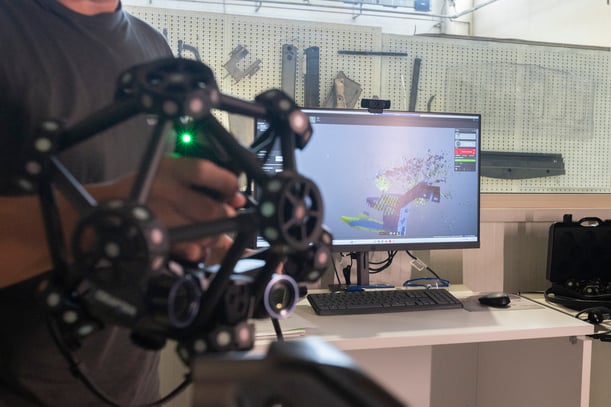
For an OEM, being able to access:
- dimensional trends,
- statistical data,
- process deviations,
- inspection history,
- and correlations between batches and machine parameters,
means greatly increasing the level of visibility and reducing operational risk.
This becomes even more important in high-volume production, where even small drifts can quickly amplify.
Real traceability: lot, serial and component history
Another decisive criterion is traceability.
Today, major OEMs are increasingly demanding the ability to quickly rebuild:
- material provenance,
- production lot,
- production time window,
- controls performed,
- associated parameters,
- and serialization of the component.
The goal is simple: to enable fast and effective containment.
When a deviation emerges, the buyer wants to know immediately:
- which parts are involved,
- where they are located,
- which customers are affected,
- and what data support the decision.
A supply chain without effective traceability makes this much slower and riskier.
Containment: the true test of partner strength
In the end, the true measure of a partner's soundness emerges at the critical moment.
Not when everything is working perfectly.
But when something deviates.
That's when a technical buyer really evaluates:
- speed of reaction,
- quality of information,
- containment capacity,
- availability of data,
- and level of process control.
A solid industrial partner is not one that promises "zero problems."
It is the one that succeeds in:
- quickly identify the risk,
- circumscribe it,
- correct it,
- and restore stability without generating escalation along the supply chain.
And this is where process integration, data availability, and direct control of critical processing become a real operational advantage.
Because it makes no sense to internalize everything
To talk about internalizing critical processing is not to argue that an OEM, or an industrial partner, should produce everything in-house.
On the contrary, one of the most frequent mistakes in industrial strategies is to turn vertical integration into a dogma.
In the modern manufacturing environment, the goal is not to maximize the number of in-house processes.
The goal is to reduce operational risk while maintaining flexibility, competitiveness and adaptability.
And these elements do not automatically coincide with total supply chain relocation.
In recent years, many companies have reevaluated the issue of manufacturing integration after logistics crises, material shortages, increased lead times and geopolitical instability. However, the most recent analyses of industrial resilience clearly show that the most robust supply chains are not necessarily the most "closed".
They are the ones that manage to balance:
- control,
- agility,
- adaptability,
- responsiveness,
- and cost of resilience.
In other words: completely replacing dependence on external suppliers with an overly rigid internal structure may generate new problems.
Because every internalized activity involves:
- investment,
- production capacity to be saturated,
- fixed costs,
- management skills,
- maintenance,
- operational control,
- and organizational rigidity.
If a process is not really critical from the point of view of quality, production continuity, or OEM risk, internalizing it can increase complexity without creating a real benefit.
This is where the concept of selective internalization comes in.
The machining operations that make sense to preside over directly are those that concentrate:
- high impact on downtime,
- quality risk,
- sensitivity to process variations,
- criticality on special features,
- complexity of traceability,
- or high exposure to change management.
In contrast, standardized, low-risk or easily replaceable activities can also be managed effectively through well-controlled external supply chains.
For a technical buyer or senior SQE, this is a key point.
Because the real goal is not to have a supplier that "does it all."
It is having a partner who can distinguish:
- what needs to be controlled directly,
- what can be managed externally,
- and where operational risk is really concentrated.
That's a huge difference.
More mature industrial organizations are not simply looking for integration.
They are looking for balance.
A balance between:
- depth of control,
- speed of response,
- production flexibility,
- economic sustainability,
- and overall supply chain resilience.
And it is this approach that makes an industrial structure truly robust in the long run.
Because resilience does not come from doing everything in-house.
It comes from the ability to intelligently govern the workings that really matter.
Conclusion: the real advantage is not "doing everything," but controlling what really matters
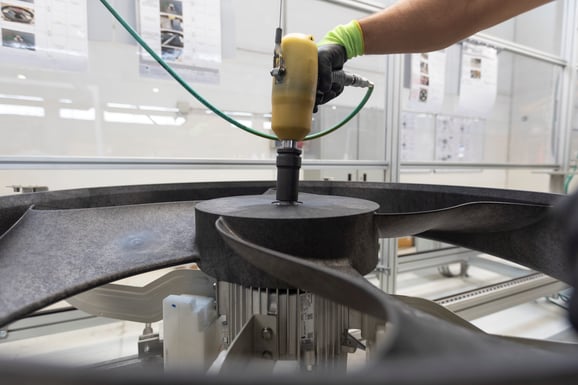 In modern OEM manufacturing, operational risk no longer depends solely on the quality of the individual component.
It depends on the ability of the supply chain to:
- react quickly,
- contain deviations,
- maintain production continuity,
- and ensure process stability even under pressure conditions.
This is why the issue of internalizing critical processing is becoming increasingly central to the decisions of technical buyers, SQEs and production managers.
Not because "doing everything in-house" is automatically better.
But because some processing concentrates too much risk to be managed through fragmented and poorly integrated supply chains.
When processes such as:
- robotic laser cutting,
- carpentry,
- robotic welding,
- painting,
- cataphoresis,
- plastic injection molding,
- thermoforming,
- and assembly
are governed within the same industrial perimeter, the level of control increases significantly.
It increases the speed of response. It improves traceability. Blind spots between process and final quality are reduced.
Most importantly, you reduce the time it takes to identify, contain and correct a problem.
For OEMs operating in production-intensive industries, such as: material handling, agricultural machinery, construction equipment or industrial HVAC, this aspect means concretely reducing the risk of:
- downtime,
- quality escalation,
- warranty claims,
- logistical inefficiencies,
- and loss of production stability.
In the end, the real issue is not the amount of processing handled internally, but what processes really affect reliability, continuity, and operational risk, and how well the industry partner is structured to govern them in a consistent, traceable, and responsive manner.
This is where the strength of an industrial partnership is measured. And this is where an integrated approach can transform from a simple manufacturing capability to a real competitive advantage.
If you are considering how to reduce operational risk in your supply chain, the first step is not to increase the number of controls.
It is to understand which critical workings deserve a higher level of integration and governance.
TR Industrial supports industrial OEMs in the integrated management of critical high-complexity processes, combining metal machining, special processes, plastic components, and assembly within a single manufacturing ecosystem designed for mass production and high-reliability supply chains.