Production Peaks and Continuity: Why Integrated Capacity Makes the Difference
In the industrial manufacturing context, managing production peaks is one of the most critical factors for operational stability. In high-intensity sectors—such as material handling, forklifts, lifting equipment, HVAC, and industrial machinery—demand is not linear but characterized by fluctuations, sudden surges, and increasingly tight time windows.
In these scenarios, the key issue is not simply installed production capacity, but the supplier’s ability to ensure operational continuity even under plant saturation conditions, while maintaining quality standards, delivery times, and process consistency.
For technical buyers and production managers, this translates into a strategic question:
Is the supplier able to sustain the load when the supply chain comes under pressure?
Plant Saturation: When the System Enters a Critical Zone
Every production system has a balance point between capacity and demand. When this balance is exceeded, the system enters a saturation phase.
At this stage, typical dynamics emerge:
- Increase in actual lead times compared to planned ones
- Loss of priority in order management
- Increase in rework and scrap rates
- Congestion in internal and external logistics flows
- Higher probability of quality deviations
For an OEM producing complex machinery—such as forklifts, lifting platforms, or HVAC systems—the risk is direct: a single disruption in component supply can slow down or halt the entire assembly line.
The critical point is that this condition does not depend solely on volume, but on the structure of the supply chain.
A supplier with processes distributed across multiple subcontractors is inherently more exposed to saturation. Each outsourced operation—whether welding, painting, plastic processing, or assembly—introduces variability and reliance on external capacity that is not fully controlled.
Fragmented Supply Chain vs Integrated System: Impact on Lead Time
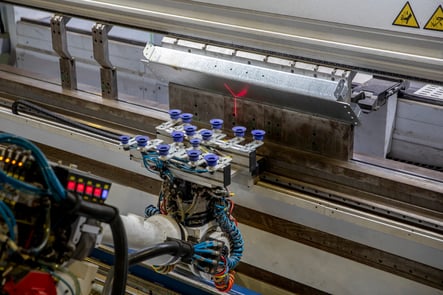
In the traditional model, many operations are distributed:
- Laser cutting with one supplier
- Bending with another
- Outsourced robotic welding
- Painting or cataphoresis handled externally
- Plastic injection molding assigned to separate suppliers
- Thermoforming carried out on external dedicated lines
This approach inevitably leads to:
- Longer throughput times
- Greater coordination complexity
- Increased intermediate transportation
- Loss of control over intermediate quality
During production peaks, this structure reveals its limitations: every node in the chain becomes a potential bottleneck.
Conversely, an integrated production system—where the main processes are managed internally—enables much more efficient flow management.
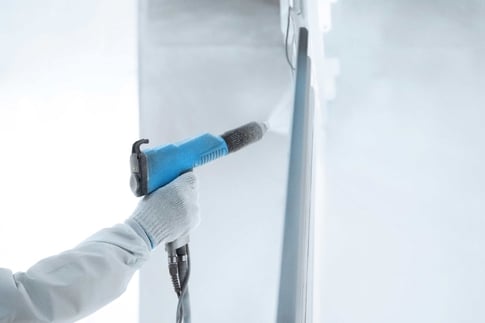
The integration of processes such as:
- 2D/3D laser cutting
- Sheet metal bending
- Robotic welding
- Powder coating and cataphoresis
- Plastic injection molding
- Thermoforming
- Assembly
significantly reduces throughput times and increases responsiveness.
Production Capacity vs Response Capacity: A Critical Distinction
One of the most common mistakes in supplier evaluation is focusing solely on nominal production capacity.
However, in complex industrial environments, operational response capacity is far more important.
The difference is substantial:
- Production capacity: the maximum theoretical output
- Response capacity: the ability to adapt to changes in load, priorities, and product configurations
A supplier may have advanced equipment but still be inefficient if it cannot:
- Quickly reallocate resources
- Manage priority changes
- Coordinate multiple operations in parallel
- Support design improvements to simplify production
For technical buyers and SQEs, this translates into a key implicit KPI: supplier adaptation time to change.
The Role of Robotic Welding in Managing Peaks
Welding is often one of the most critical stages in structural components for lifting and handling equipment.
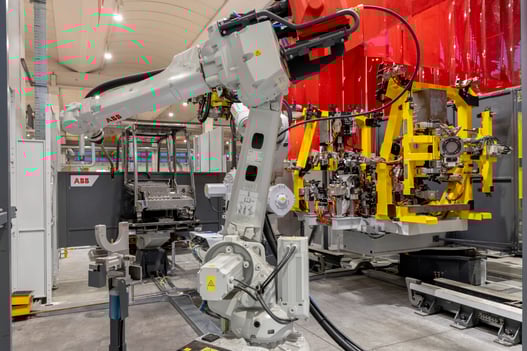
The introduction of robotic welding systems enables:
- Greater process repeatability
- Reduced operational variability
- Increased productivity
- Better handling of high volumes
In peak conditions, robotic welding becomes a strategic lever, allowing production scaling without compromising quality.
Moreover, integrating welding within the same production flow eliminates downtime related to transport and waiting between suppliers.
Plastic Injection Molding: Stability and High Volumes
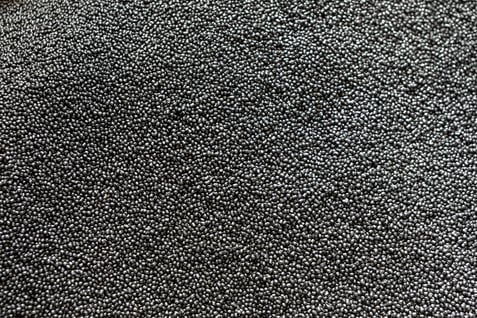
For plastic components—such as covers, panels, protective parts, and technical structures—plastic injection molding is a key technology for high-volume production.
Compared to other technologies, it offers:
- High geometric precision
- Process repeatability
- Lower unit costs at scale
- Stronger quality control
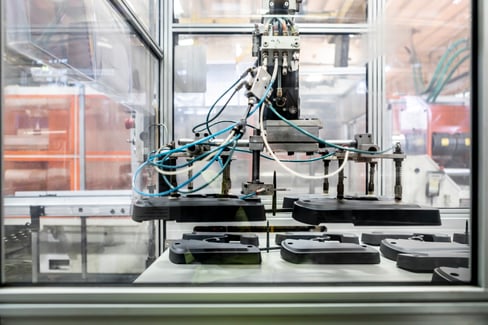
During peak phases, internal availability of injection molding lines allows:
- Avoidance of external bottlenecks
- Synchronization with metal processing operations
- Reduction of overall procurement lead times
This is particularly relevant for OEMs requiring hybrid metal-plastic components ready for assembly.
Thermoforming: Flexibility and Variant Management
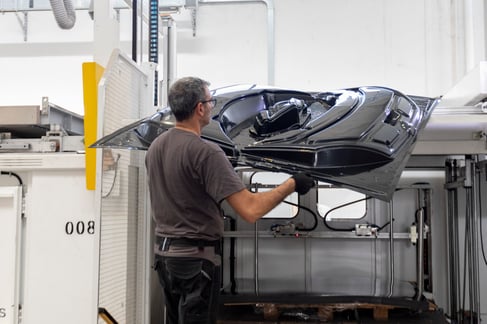
Thermoforming is a complementary solution to injection molding, especially for:
- Large components
- Medium-low volumes
- Prototyping or pre-series
- Complex geometries
Within an integrated system, thermoforming enables rapid management of product variants without the need for heavy investment in molds.
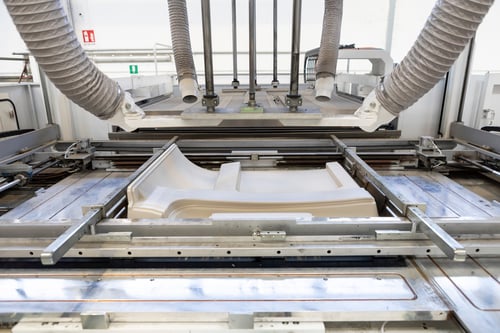
During production peaks, this flexibility can be decisive for:
- Absorbing temporary demand fluctuations
- Managing low-rotation part numbers
- Supporting transitions between product versions
Industrial Resilience: Reducing Failure Points
Supply chain resilience directly depends on the number of uncontrolled variables.
Every external step introduces:
- Logistic risk
- Quality risk
- Time-related risk
An integrated system reduces these risks because it:
- Centralizes control within the same organization
- Allows immediate intervention in case of issues
- Improves process traceability
For multinational OEMs, this is a key factor, especially when dealing with quality audits, strict regulations, and the need for standardization.
Quality Under Pressure: The True Test
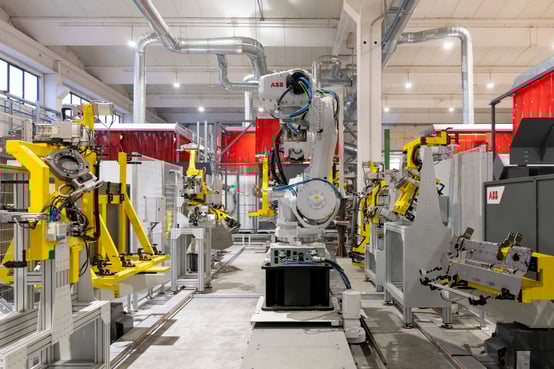
During production peaks, quality is the first element at risk.
When the system is under stress:
- Process deviations increase
- Time available for inspections decreases
- The risk of non-conformities rises
A structured supplier must be able to maintain:
- Consistent quality standards
- Statistical process control
- Full traceability
even under saturation conditions.
This is only possible through:
- Process automation
- Integration of operations
- Internal quality control systems
Logistics and Large Components
In the case of large components—typical of lifting equipment—logistics becomes a critical factor.
Poorly optimized transport can lead to:
- Damage
- Loading inefficiencies
- Increased costs
An integrated approach enables the design of dedicated logistics solutions:
- Modular containers
- Returnable systems
- Space optimization
with direct benefits on cost, quality, and operational continuity.
Simplifying Operations with a Single Point of Contact
For technical buyers and procurement managers, multi-supplier management represents a significant operational cost.
An integrated partner enables:
- Reduction in the number of interlocutors
- Simplified communication
- Better visibility on progress status
- Faster decision-making processes
This approach is particularly effective in complex projects where synchronization between processes is critical.
Conclusion: Integrated Capacity as a Strategic Lever
Production peaks cannot be eliminated.
But they can be managed in a structured way.
The difference between a fragile and a resilient supply chain lies in the supplier’s ability to:
- Absorb volume fluctuations
- Maintain consistent quality
- Reduce response times
- Manage key processes internally
In this context, integrated capacity is not just an operational advantage.
It is a strategic lever to ensure production continuity, reduce risk, and sustain long-term industrial competitiveness.